 CultureCulture
The Northeast sky erupted in a spectacular, yet jarring, display on Saturday, May 30, 2026, as a meteor tore through the atmosphere and exploded, sending a powerful sonic boom across multiple states. Homes rattled, residents were startled, and the event quickly became the talk of social media and local newsrooms, spanning a vast area from Montreal down to Delaware.
The celestial phenomenon unfolded just after 2 p.m. Eastern Daylight Time, with reports of the thunderous boom pouring in around 2:06 p.m. EDT. What began as a fiery streak in the sky culminated in a fragmentation at an altitude of roughly 40 miles (64 km), directly over northeastern Massachusetts and southeastern New Hampshire. Initial confusion gave way to scientific confirmation, as satellite lightning data from the National Oceanic and Atmospheric Administration (NOAA) captured a signature precisely matching a meteor at the time the boom was reported.

NASA later stepped in to confirm the event, providing staggering details about its intensity. The agency estimated that the energy released during the meteor's breakup was equivalent to approximately 300 tons of TNT. This immense energy output was the driving force behind the powerful sonic booms that reverberated across the region, shaking structures and sending shivers through communities. The object itself was described by the American Meteor Society as being about three feet (one yard) wide, traveling at an astonishing speed of 75,000 miles per hour (more than 120,000 km/h) when it disintegrated.
Explaining the nature of the event, NASA's deputy news chief, Jennifer Dooren, clarified that "This fireball was not associated with any currently active meteor shower, but it was a natural object and not a re-entry of space debris or a satellite." Robert Lunsford, the Fireball Program Monitor with the American Meteor Society, echoed the sentiment, noting its unusual size. "It was definitely bigger than a normal fireball, about a yard wide," Lunsford stated. He also commented on its likely fate, indicating that if it hadn't completely burned up, it would have landed in the ocean, as most meteors do.
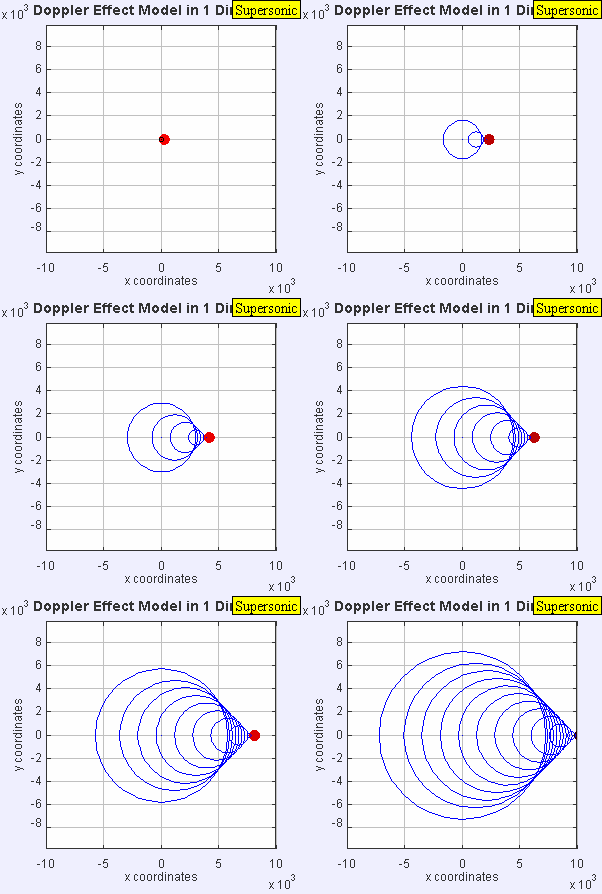
The intense pressure waves generated by objects moving at such extreme speeds through the atmosphere are what create a sonic boom. Shauna Edson, an astronomy educator for the Smithsonian National Space and Air Museum, elaborated on this phenomenon. "What you hear is the air compression of it moving really fast, creating those pressure waves, and occasionally sometimes you're also hearing the stone itself break apart from the forces that it's going through," Edson explained. Unlike the localized tremors of an earthquake, these booms travel along a linear path from the meteor's trajectory, allowing them to be heard over vast distances.
Meteorologists were quick to analyze the available data. WBZ-TV chief meteorologist Eric Fisher was among the first to provide analysis, stating, "On our lightning mapper, on satellite data, you can see where exactly that came into the atmosphere very close to Boston, causing all of that excitement." NBC10 meteorologist Pamela Gardner also pointed to a meteor or bolide, posting on X that "Big explosion/boom around Boston. GLM from GOES 19 shows possible meteor or bolide entering the atmosphere. There is no lightning in this current storm, no earthquake from USGS." Spaceflight meteorologist Nick Stewart concurred, noting, "The flash density product really shows this anomalous 'flash' which is pretty distinctive of a bolide/meteor reentry east of Boston. This is the likely source of the loud boom/explosion."
The impact on residents was immediate and startling. One individual in Melrose, Massachusetts, told WCVB that "The whole house, actually all houses in the neighborhood shook. Much louder than a transformer exploding and definitely not an earthquake." Another resident in Needham, Massachusetts, commented on Fisher's video, describing their experience: "Heard and felt in Needham. We thought a tree fell on our house." The widespread reports prompted a response from the U.S. Geological Survey (USGS), which confirmed that despite numerous "Did you feel it?" submissions, no earthquake activity was registered on its seismographs, effectively ruling out a seismic event.
Official channels also responded to the public's concern. The Massachusetts Executive Office of Public Safety and Security and the Massachusetts Emergency Management Agency (MEMA) acknowledged the widespread reports of an "audible boom and ground tremors." They initially reassured the public, stating, "Although we do not yet know the cause, there are no known emergency police or fire requests connected to these reports, and we do not believe that there is any public safety threat." This helped to quell fears as the scientific explanation became clearer.
This event over Massachusetts is not an isolated incident but rather fits into a broader pattern of increased meteor activity observed recently. Scientists with the American Meteor Society have documented an unusual rise in large fireball events and accompanying sonic booms during the early months of 2026. Just the day before the New England incident, residents across South Carolina reported a mysterious blast, which the USGS later attributed to a sonic boom, though its precise origin remains under investigation. Days after the Massachusetts event, another powerful fireball over Texas generated a significant shock wave and scattered meteorites, with one fragment reportedly crashing through a home's roof.
Other notable occurrences include a meteor over Ohio in March 2026 and another over midtown Manhattan in July 2024, highlighting a period of heightened celestial activity. These events serve as a powerful reminder of the ancient cosmic debris that constantly interacts with our planet's atmosphere. While most meteors are small and burn up harmlessly, larger objects can create these spectacular displays and powerful shock waves. Researchers consistently emphasize that despite these occurrences, there is currently no evidence of an impact threat to Earth, ensuring that for now, these cosmic visitors remain a source of wonder rather than alarm. The ongoing documentation of such events continues to deepen our understanding of our solar system and its dynamic environment.